Apple’s iPad has been the poster child of the “post PC era” ever since its inception. As the device has matured however, it has gained competition from practically every company that can build a hardware device, from Microsoft to Samsung. Its reviews have gone from praising it as the harbinger of the post PC era to how its interactions are broken to a point where it will never serve the generic handheld computing device purpose it was once slotted into.
At least by the media.
Steve Jobs knew this wasn’t going to be the case (http://www.cnet.com/news/steve-jobs-let-the-post-pc-era-begin-live-blog/),
When I am going to write that 35-page analyst report, I am going to want my Bluetooth keyboard. That’s 1 percent of the time. The software will get more powerful. I think your vision would have to be pretty short” to think these can’t grow into machines that can do more things, like editing video, graphic arts, productivity. “You can imagine all of these content creation” possibilities on these kind of things. “Time takes care of lots of these things.”
I agree with the sentiment. For a majority of the use cases, the iPad and others of its ilk will do just fine. But as we start to mature in our use of such devices, the simplistic interfaces that exist today just won’t cut it. What we need next are methods that make this device even more powerful than it is today – and that is by unleashing a whole new series of content creation paradigms.
Think about spreadsheets – Microsoft Excel for iPad has *just* been released – four years after the original iPad came out. And we still can’t run macros on it. Because of a policy decision somewhere in the Apple ecosystem, the most dominant end user programming language that comes with Excel is unusable on the tablet – which completely undermines one of the most powerful features that desktop Excel offers. And more importantly, not one spreadsheet with macros can run on the iPad – effectively rendering Excel for iPad useless for cross computer collaboration.
Lest one think spreadsheets are an isolated case, consider the work flow in writing this blog post and publishing it. Once I figure out what I’m writing about and what the essential facts I want to convey are, my flow is mostly split between composing text in a text editor, and using a browser to do research – gathering quotes, images, et al and somehow embedding it in the post. A trivial task on the desktop, with the availability of quick app switching, lots of screen real estate, and simple to use copy/paste. Not to mention having persistent storage on your hard drive. On the current tablet model, this simple task becomes needlessly complicated. The drawback of being able to run only one application at a time means that more time goes switching between apps than does in actually getting effective work done.
The next big revolution has to be in defining paradigms for these oft used, non trivial interactions in the touch world. The company or product that lights the way in doing so will capture a significant portion of mind-share and, hopefully, the market. Which is not to say there aren’t a few positive trends in this direction – (http://www.gethopscotch.com/) for kids that allows one to build an iPad app from within an iPad is quite excellent. For the first time, you can actually use the tablet to create content for it. But it’s early days yet.
This week saw a couple of interesting developments in the world of tablet computing though.
Microsoft (http://thenextweb.com/microsoft/2014/05/30/surface-pro-3-review/) which, as per almost every review I’ve read so far, is being hailed as a laptop killer. After looking at videos, pictures and specs, I’m inclined to agree. It can run all kinds of native windows applications, offers a solid keyboard, a stylus for precision work and a form factor that makes it not appear as a compromise as Microsoft’s earlier tablets were wont to do. But one of the biggest disadvantages is that it tries to replace a laptop – meaning it offers a sleeker, thinner, lighter, touch screen enabled version of a traditional laptop that can compete in the ultrabook market. But there’s no innovation in the touch interaction arena there. In my book, that is a mistake.
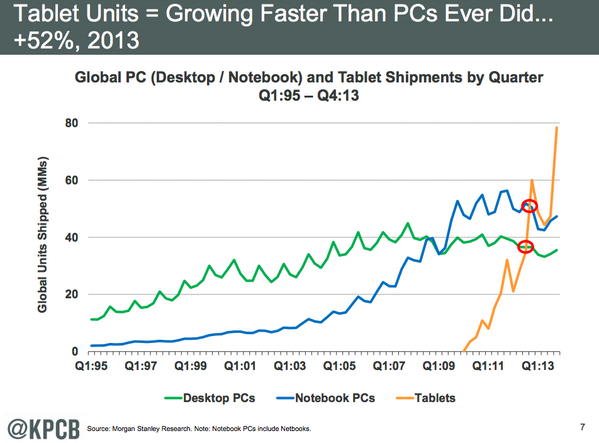
Mary Meeker released her State of the Internet presentation, arguably the one presentation in the year which seems to be an event unto itself. In it, she presents (https://pbs.twimg.com/media/Bo_Afm0IMAAdoxS.png) that blows away the recent meme of “tablets have peaked and are dying” – almost 80 million tablets were sold, which equals the combined numbers of desktop and laptop computers!
What this means is that all of a sudden, Microsoft has a tablet that rivals a macbook air in the kind of functionality it offers. You can run full apps on it, and it offers a trackpad to do finegrained manipulation. Apple on the other hand has an entrenched tablet that hasn’t really moved the needle recently in terms of game changing features, and offers watered down versions of full scale desktop applications that the Surface can run.
What we’re missing is someone to show the way on what the next generation of tablet interactions are going to look like.
--
If you have any questions or thoughts, don't hesitate to reach out. You can find me as @viksit on Twitter.
Quoting Ramchandra Guha,
In his pomp — which ran roughly from 1948 to 1960 — Nehru was venerated at home Representative are these comments of The Guardian, written after the Indian prime minister had addressed a press conference in London in the summer of 1957:
‘A hundred men and women of the West were being given a glimpse of the blazing power that commands the affection and loyalty of several hundred million people in Asia. There is nothing mysterious about it. Mr Nehru’s power is purely and simply a matter of personality. … Put in its simplest terms, it is the power of a man who is father, teacher and older brother rolled into one. The total impression is of a man who is humorous, tolerant, wise and absolutely honest.’
Perhaps written unwittingly, those last sentences have the potential to become the guiding light to anyone who seeks to lead any group of people towards anything.
As Narendra Modi steps into the Indian Prime Minister’s role today, it would be wise of him to keep those sentiments in mind and look to guidance not from his immediate set of predecessors, but atleast in some respects, from the man who started it all.
--
If you have any questions or thoughts, don't hesitate to reach out. You can find me as @viksit on Twitter.
It is the combination of things we remember that point out how certain places are special to us, hallowed by their unique features and our own experiences in them. It matters not whether we intended to go there, or whether a series of serendipitous choices led us there.
What matters is that there will always remain memories and thoughts that make such places important in our lives – they are not just physical locations anymore, but are defined by the veneer of history that everyone who goes there leaves on them. Embedded within these layers are the people we were with, the events that took place there, and those that almost did. There are landscapes and beaches, skylines and walking trails, restaurants and cafes and a host of other places that together with the dust and grime of the present grow to be places with character. They recount the fun conversations and stories by the bonfires on the beach, of shared campgrounds and hastily pitched tents, beautiful sunsets and walks on steep trails, jumping into hot tubs and drives across beautiful vistas, of wines tasted in the brilliant sun and dinners in lush riverside restaurants, of people met in passing that we may never see again and of friends made along the way who are today important influences in our life; of people telling us how lucky we were there at just the right time and of a sense of accomplishment of achieving things we never thought possible – or even considered doing, of messed up timings and missed dinners, of lying randomly on beaches and staring at starry skies, of shared food and localized disappointments, of train journeys and sudden passport checks within borders, of passing samaritans with offers of food and help, of breathtaking events and funny incidents, and of all the times just spent enjoying the moment, with past worries and future tensions becoming completely non existent.
These are memories within all of us which we can go back to retrieve, drawing them out wisp by wisp till something – be it a snatch of music on a passing station, the whiff of food on a campfire, a familiar perfume, the road sign pointing to a familiar location, the smell of eucalyptus, or just the mention of something that takes us back to a particular time and place – binds them all together and takes them from just being tenuous threads in our heads to being a solid, real mixture of events, interactions, people and places which drive our passions, soothe our hearts, shapes our experiences, and ultimately, make us who we really are.
We are, after all, nothing but the stories we create for ourselves.
--
If you have any questions or thoughts, don't hesitate to reach out. You can find me as @viksit on Twitter.
When the inimitable Mr Seth,
penned that beauty, The Golden Gate,
little did he dream that one day he would,
inspire a rhyme, that if it could,
serve as an ode to that gorgeous book,
and inspire others to take a look,
at a city he spied from across the bay,
its skyline rising on a gorgeous day,
from Indian rock out there in Berkeley,
or from the top of the campanile,
the fog framing its rolling hills,
lending its residents some shivers and chills,
and inspiring him, as if in a dream,
to voice his thoughts in a stream,
and pen a tale like none before,
one that would go down in lore.
When I first heard of this story in verse,
in iambic pentameter, and not at all terse,
I was in awe, as some thoughts arose,
grasping a book in poetry, not prose,
for the last of the epics that I knew with rhymes,
had been written in ancient times,
here was someone starting afresh,
and competing with the likes of Gilgamesh,
I decided then it was worth a read,
who knows after all, where it would lead?
and so one day, after a copy was mine,
I sat down to read, while it was still sunshine,
the pages, they went flying quickly past,
the next much more alluring than the last,
telling the tale with much charm and style,
with wit and verse taking it that extra mile,
the story of four friends, John and Jan,
Liz and Phil, and even Paul, the also-ran,
weaving the ups and downs of modern life,
of love and laughter, and of trouble and strife,
into a tapestry of colors bound together so well,
that the rhyme you read, must on it dwell.
The twists of fate they say have a will of their own,
and that you reap the seeds you’ve sown,
but I personally think these thoughts quite trite,
even though I may someday believe them right,
it’s hard not to get yourself drawn,
into the story, as it goes merrily on,
and pause to reflect on what things might’ve been,
if you yourself had been in the scene,
for, would you be that dreamer John,
on whom many a woman would fawn?
or perhaps you have all the charm and fizz,
of that lovable lawyer girl, Liz,
where would you be if your life was Phil’s,
trod upon, but bearing life no ills,
or for that matter, the sensible artist Jan,
making sculptures and paintings only as she can?
The tale is over then, it’s been sublime,
this quintessential californian novel in rhyme,
has done what it tried to strive
for, brought our four friends alive,
one is sad that this comes to pass,
the last page is finally turned, alas.
—
One day, walking around Dolores Park,
ideally of course, when it’s getting dark,
there is a spot where you can stand,
with someone you love, perhaps, close at hand,
and stare across, to the twinkling lights,
taking in the beautiful sights,
the bridge in the distance, all aglow,
zigzagging lights, a crown on show,
your mind’s at peace, your face a smile,
without you realizing all this while,
the wind blows from across the bay,
the trees in front of you lightly sway,
a fog horn in the distance calls,
and slowly then, a silence falls,
this enchanting city yet again enthralls,
a dreamer, but this time within its walls,
to pen a rhyme about this city fair,
the golden gate looks on, from somewhere out there.
PS. With all due inspiration to Vikram Seth.
--
If you have any questions or thoughts, don't hesitate to reach out. You can find me as @viksit on Twitter.
But tonight, I can’t help but feel bad about what he must feel, huddled in the small space without a roof, trying his best to protect himself from the increasingly wild rain.
I can’t imagine the events that brought him to this, but I just wish life had been fairer to him.
--
If you have any questions or thoughts, don't hesitate to reach out. You can find me as @viksit on Twitter.